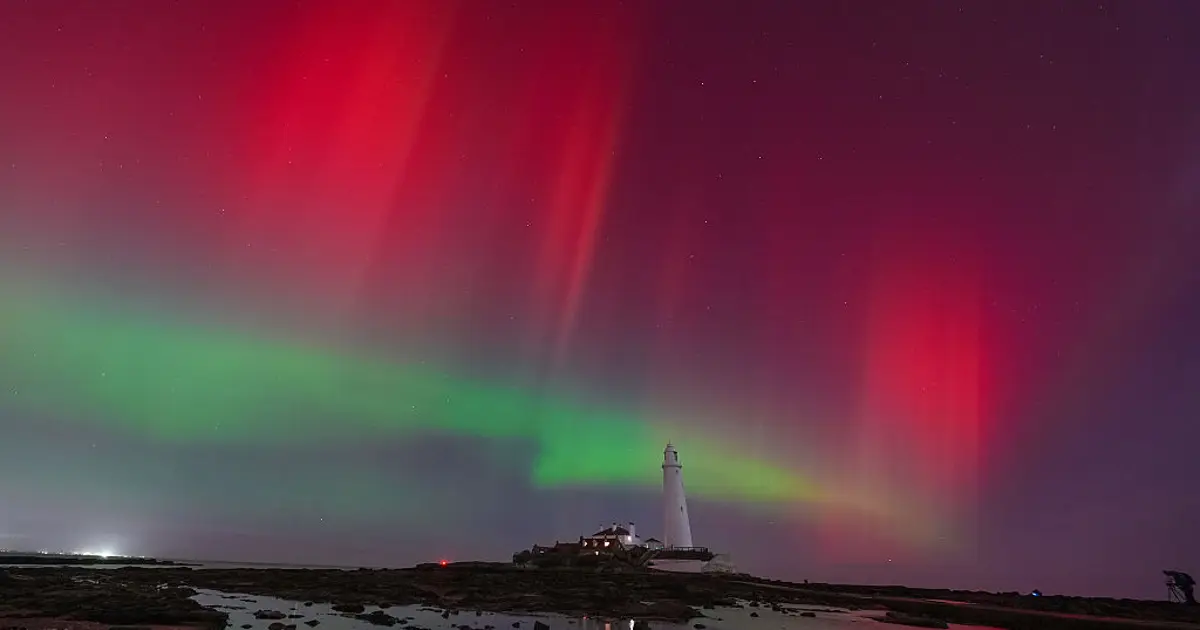
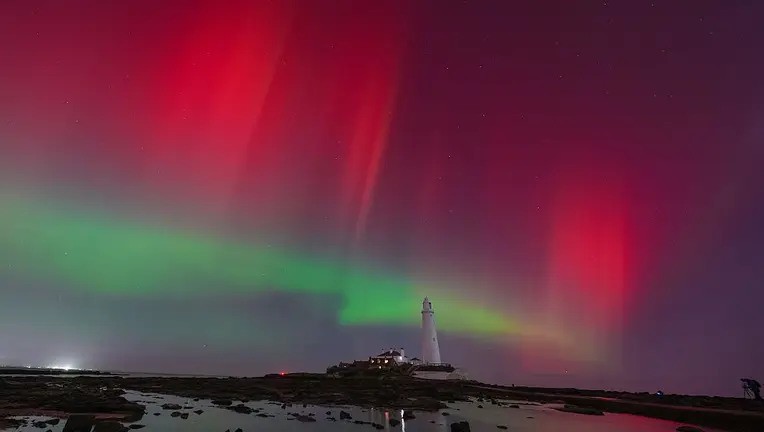
The aurora borealis, also known as the northern lights, glow in the sky over St Mary’s Lighthouse in Whitley Bay on the North East coast, reaching a G4 level geomagnetic storm, putting on an amazing display in the early hours. Picture date: Wednesday
Read more March of Dimes walk brings Tampa Bay families together to raise awareness for premature births
A powerful stream of solar wind flowing from a massive coronal hole in the sun’s atmosphere may trigger a geomagnetic storm Thursday and Friday, creating favorable conditions for viewing the Northern Lights.
Why you should care:
The National Oceanic and Atmospheric Administration’s (NOAA) Space Weather Prediction Center says people living in parts of the northern United States — including areas of New York, Idaho, Michigan, Minnesota, North Dakota, Montana and Washington — could have an opportunity to witness the aurora during the event.
NOAA has issued a Geomagnetic Storm Watch for both Thursday and Friday, noting that the most intense geomagnetic activity is expected between 11 p.m. and 2 a.m. EST.
RELATED: Eiffel Tower-sized asteroid Apophis to pass closer to Earth than many satellites in 2029, NASA says
Forecasters say elevated geomagnetic conditions are likely to persist into Friday night as continued solar wind activity interacts with Earth’s magnetic field.
Read more Father arrested for DUI with 5-year-old in the backseat: HCSO
Dig deeper:
The Northern Lights, or aurora borealis, are known for their vivid colors and flowing patterns. NASA describes them as an “intricate dace of intricate dance of particles and magnetism between the sun and Earth.”
Although auroras are expected to be active Thursday and Friday, visibility will still depend on several conditions, including cloud cover, darkness levels and how Earth’s magnetic field reacts to the incoming solar winds, according to space.com.
RELATED: Astronomers surprised by atmosphere around tiny world in the outer solar system
Even during strong geomagnetic storms, seeing the aurora is never certain.
What you can do:
Experts recommend finding a dark location away from city lights or streetlights for the best viewing experience. Lying flat on your back and allowing your eyes time to adjust to the darkness — usually about 30 minutes — can improve your chances of spotting the lights.
Using a smartphone camera may also help reveal faint auroras that are difficult to see with the naked eye.
Read more Alex Murdaugh retrial could bring potential death penalty
About the Author