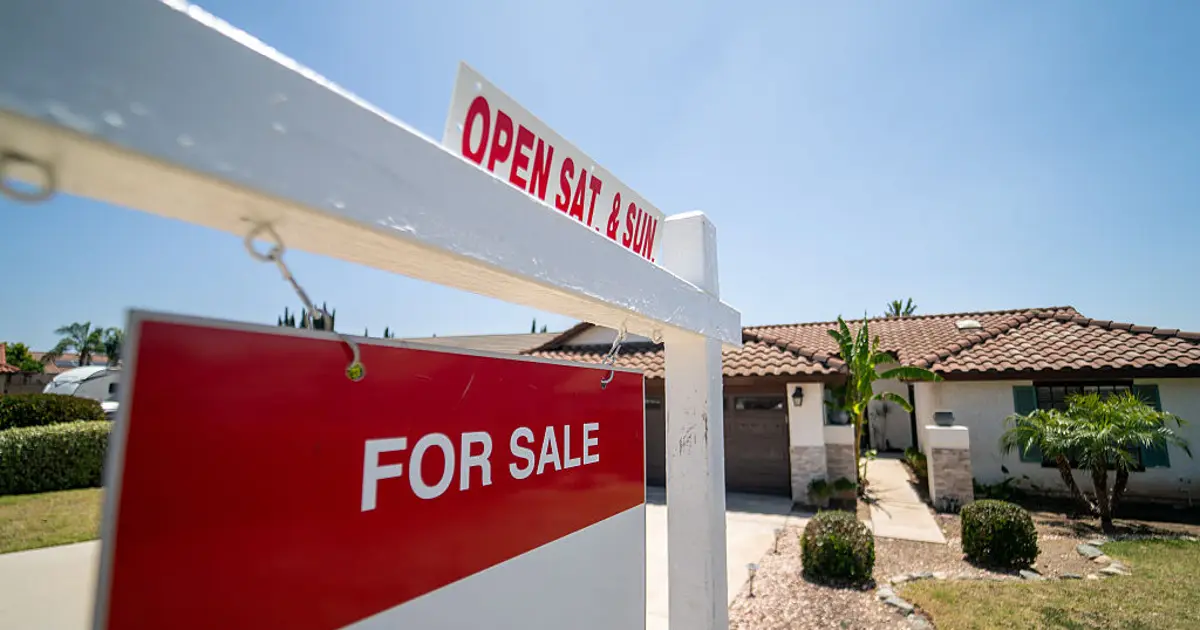
A “For Sale” sign outside a home in Rancho Cucamonga, California, US, on Saturday, May 9, 2026. Photographer: Kyle Grillot/Bloomberg via Getty Images
Read more Korean street food restaurant opens near USF in Tampa
Mortgage rates declined this week to their lowest level in more than a month, according to mortgage finance giant Freddie Mac.
By the numbers:
Data from Freddie Mac’s Primary Mortgage Market Survey released Thursday showed the average rate on a 30-year fixed mortgage fell to 6.47%, down from 6.52% a week earlier. A year ago, the average rate stood at 6.81%.
“Incoming data continues to reflect a resilient consumer, with retail sales improving and pending home sales strengthening, suggesting purchase demand is continuing to modestly improve,” said Sam Khater, Freddie Mac’s chief economist.
RELATED: Home sellers could boost offers by thousands with this surprising paint color
The average rate on a 15-year fixed mortgage also edged lower, slipping to 5.81% from 5.84% the previous week.
Big picture view:
Mortgage rates have remained elevated in recent weeks as geopolitical uncertainty surrounding the conflict involving Iran rattled financial markets. On June 17, President Donald Trump signed a memorandum of understanding during meetings in France, while Iranian officials signed the agreement remotely. The temporary framework calls for an immediate halt to hostilities, the reopening of the Strait of Hormuz, limits on Iran’s stockpile of enriched uranium and a 60-day period to negotiate a broader agreement addressing Tehran’s nuclear program.
The framework also includes measures aimed at easing economic pressure on Iran, such as granting access to some frozen assets and lifting certain restrictions. Critics, however, argue the agreement offers significant concessions without requiring Iran to immediately dismantle its nuclear infrastructure.
Read more Armed teenagers arrested at Brandon Mall after threatening victim: HCSO
RELATED: States with the most and least affordable homes for 2026
“The previous weeks have been filled with constant back-and-forths, showing progress toward a resolution, only to be followed by heightened military action,” said Realtor.com senior economist Anthony Smith. “However, the latest rounds have proven more promising than previous periods of reprieve, as a tentative deal has now been drafted and now signed by President Trump.”
Dig deeper:
Mortgage rates are influenced by a variety of factors, including Federal Reserve policy and global events. While mortgage rates are not directly tied to the Fed’s benchmark rate, they tend to move alongside the yield on the 10-year Treasury note, which hovered around 4.45% Friday afternoon.
The Federal Reserve announced Wednesday that it would leave interest rates unchanged, citing concerns that inflation remains elevated amid the conflict involving Iran. The decision marked an early test for Federal Reserve Chairman Kevin Warsh as he begins his tenure leading the central bank.
Fed officials voted unanimously to keep the federal funds rate in a range of 3.5% to 3.75%. The move follows similar decisions in January, March and April after the central bank delivered three consecutive quarter-point rate cuts in September, October and December.
RELATED: US existing-home sales jump to highest level since December
In its policy statement, the Federal Open Market Committee said inflation remains above the Fed’s 2% target, noting that price pressures are “in part reflecting supply shocks that have driven price increases in certain sectors, including energy.”
“Warsh used his first decision as chair to signal a broader regime change: the easing bias is gone, forward guidance has been shelved, and the committee’s statement was rewritten around a single, unhedged commitment to delivering price stability,” Smith said. “Markets responded with a jump in the 10-year Treasury and rising odds of a rate hike before year’s end. The logic of Warsh’s approach, earning credibility by following through rather than telegraphing, is sound and ultimately the path to lower long-term rates. But a market without clear guidance may demand a premium in the near term, which could keep mortgage rates from falling as quickly as the Iran ceasefire alone might suggest.”
About the Author